|
||||||||
| MASM | MASM help | Using MASM | Getting started | GitHub | Programmer’s guide | |||
|---|---|---|---|---|---|---|---|---|
| x86 Instruction reference | MASM reference | MASM Cheat Sheet | Reserved Words | |||||
| Others | Intel x86 | Visual Studio | C/C++ | |||||
| General Information | Discord | EE/CS Wiki | EITS | Textbook | Stack Overflow | |||

| Syllabus: Fall 2026 | Credit hours: 3 | |
| Class times: 10:10am – 11:00am, MoWeFr | Classroom: Harrington Hall 108 | |
| Class # (on-campus: 250-01): 36013 | Class # (on-line: 250-02): 36014 | |
| Prerequisite: CSCI 160 Computer Science I | ||
| Instructor: Wen-Chen Hu (my teaching philosophy) | Office: Upson II 366K | |
| Office hours: 12:30pm – 02:00pm, MoWeFr | ✉ Email: wenchen@cs.und.edu | |
 :
https://und.zoom.us/j/2489867333 :
https://und.zoom.us/j/2489867333
|
UND Zoom sign in: https://und.zoom.us | |
| TA: Bruno Fonkeng | Office: Harrington Hall 221 | |
| :
https://und.zoom.us/j/4569996871
|
✉ Email: bruno.fonkeng@und.edu | |
| Office hours: 09:00am – 10:30am, TuTh | ☎ Phone #: (701) 777-9355 | |
Synchronous class delivery: The class lectures will be delivered synchronously via https://und.zoom.us/j/2489867333, and the Zoom video will be posted on the Blackboard afterwards. Students can watch the video clips anytime they want.
Textbook (recommended): Assembly Language for x86 Processors, 8th ed., Kip Irvine, Pearson, ISBN: 978-0135381656
Lecture notes: Other than the textbook, award-winning, interactive, complementary, and abridged lecture notes (based on the textbook and other online documents and user manuals) and detailed and precise class instructions will be provided. Collectively, the lecture notes and instructions are more like a small book, which supplies much more information than regular notes do and makes the subject studies much easier. Students will not have problem learning the subjects or taking the exams after studying them and doing the homeworks and programming exercises.
| Grading: |

|
Announcements:
- Updated constantly: Class notes
- Monday, October 19 (soft): Programming Exercise I due
- Wednesday, September 09: Programming Exercise I posted
- Monday, August 24: Register this course via Course Registration.
Tentative Schedule:
Week |
Class | Topic | Where | |||||
|---|---|---|---|---|---|---|---|---|
| 0 | ||||||||
| 0.1 A computer career | ||||||||
| 0.2 Data research | ||||||||
| 0.3 Data technologies | ||||||||
| 1 | 08/26 08/28 |
1. Introduction to CSCI 250 | ||||||
| 1.1 Course outline | ||||||||
| 1.2 Programming language generations | ||||||||
| 1.3 A language processing system | ||||||||
| 2 | 08/31 09/02 09/04 |
2. Introducation to Assembly Languages | ||||||
| 2.1 MASM | ||||||||
| 2.2 ARM | ||||||||
| 2.3 MIPS | ||||||||
| 09/02 |
Last day to add a course or drop without record — 100% refund Last day to add audit or change to/from audit Last day to receive a refund on a dropped class Drops after the last day to add will appear on a transcript. |
|||||||
| 3 | 09/09 09/11 |
3. Programming Exercise I | ||||||
| 3.1 Specifications | ||||||||
| 3.2 Construction steps | ||||||||
| 3.3 A sample program | ||||||||
| 09/07 |
|
|||||||
| 4 | 09/14 09/16 09/18 |
4. Computer Data Representation | ||||||
| 4.1 Integers | ||||||||
| 4.2 Two’s complement notation | ||||||||
| 4.3 Character storage |  |
|||||||
| 5 | 09/21 09/23 09/25 |
5. MASM Data Representation | ||||||
| 5.1 Intrinsic data types | ||||||||
| 5.2 Defining data | ||||||||
| 5.3 Little endian order | ||||||||
| 6 | 09/28 09/30 10/02 |
6. |
||||||
| 6.1 Data transfer instructions | ||||||||
6.2 MOV instructions |
||||||||
| 6.3 Load and store instructions | ||||||||
| 7 | 10/05 10/09 |
7. |
||||||
| 7.1 Arithmetic instructions | ||||||||
| 7.2 Arithmetic expressions | ||||||||
| 7.3 Status flags | ||||||||
| 10/07 (no class) |
|
|||||||
| 8 | 10/12 10/14 10/16 |
8. |
||||||
| 8.1 Multiplication | ||||||||
| 8.2 Division | ||||||||
| 8.3 Arithmetic expressions | ||||||||
| 9 | 10/19 10/21 10/23 |
9. |
||||||
| 9.1 Data-related operators | ||||||||
| 9.2 Memory addressing | ||||||||
| 9.3 Other miscellaneous instructions | ||||||||
| 10 | 10/28 10/30 |
10. |
||||||
| 10.1 Input functions | ||||||||
| 10.2 Output functions | ||||||||
| 10.3 Other miscellaneous functions | ||||||||
| 10/26 |
|
|||||||
| 11 | 11/02 11/04 11/06 |
11. |
||||||
| 11.1 Boolean instructions | ||||||||
11.2 AND instructions |
||||||||
11.3 NOT instructions |
||||||||
| 12 | 11/09 11/13 |
12. |
||||||
12.1 LOOP instructions |
||||||||
| 12.2 Decision directives | ||||||||
12.3 .WHILE directive |
||||||||
| 11/13 |
Last day to change to or from S/U grading Last day to change to or from audit grading Last day to drop a full-term course or withdraw from school |
|||||||
| 11/11 |
| |||||||
| 13 | 11/16 11/20 |
13. |
||||||
| 13.1 The runtime stack | ||||||||
13.2 PUSH and POP instructions |
||||||||
| 13.3 Defining and using procedures | ||||||||
| 11/18 (no class) |
|
|||||||
| 14 | 11/23 | 14. |
||||||
| 14.1 Local variables | ||||||||
14.2 INVOKE directive |
||||||||
14.3 PROC directive |
||||||||
| 11/25 11/26 11/27 |
| |||||||
| 15 | 11/30 12/02 12/04 |
15. |
||||||
| 15.1 Inline assembly code | ||||||||
| 15.2 Linking to C/C++ | ||||||||
| 15.3 Calling C/C++ functions | ||||||||
| 16 | 12/07 12/09 |
16. |
||||||
16.1 SAL/SHL instruction |
||||||||
16.2 SAR/SHR instruction |
||||||||
16.3 ROR instruction |
||||||||
| 17 | 12/16 |
|
||||||
| 18 | 12/22 | Grades posted before noon, Tuesday |




Instructor’s qualification:
The instructor has been teaching assembly language for more than 20 years.
In addition, he designed and implemented a POPLOG virtual machine for which both LISP and PROLOG compilers generate assembly code.
University of North Dakota Course Description (CSCI 250) —
Introduction to machine language and assembly language programming.
Concepts of assembly language and the machine representation of instructions and data of a modern digital computer are presented.
Requires students to practice assembly language programming techniques on ARM and Intel x86 architectures.
Assembly Language from webopedia.com —
Assembly language is once removed from a computer’s machine language.
Machine languages consist entirely of numbers and are almost impossible for humans to read and write.
Assembly languages have the same structure and set of commands as machine languages, but they enable programmers to use names instead of numbers.
Each type of CPU has its own machine language and assembly language, so an assembly language program written for one type of CPU will not run on another.
In the early days of programming, all programs were written in assembly language.
Now, most programs are written in a high-level language such as FORTRAN or C.
Programmers still use assembly language when speed is essential or when they need to perform an operation that isn’t possible in a high-level language.
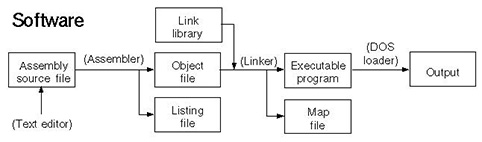
An Assemble-Link-Execute Cycle —
|

|
Computer Hardware —

|

|