TYPEDEF Operator
The operator lets you create a user-defined type that has all the status of a built-in type when defining variables. It is ideal for creating pointer variables.
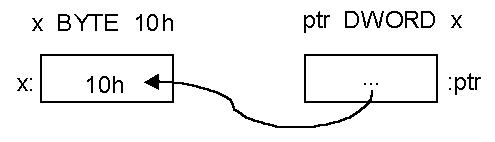
PWORD TYPEDEF PTR WORD
|
PWORD TYPEDEF PTR DWORD
|
 INCLUDE Irvine32.inc
  PWORD  TYPEDEF  PTR  WORD
 .data
  array    WORD   10h, 20h, 30h, 40h
  pointer  PWORD  array
 .code
 main PROC
     mov   ecx, LENGTHOF array
     mov   eax, 0
     mov   esi, pointer
 L1: add   ax, [esi]
     add   esi, 2
     loop  L1
     call  WriteHex
     exit
 main ENDP
 END main
|
 INCLUDE Irvine32.inc
  PDWORD  TYPEDEF  PTR  DWORD
 .data
  array    WORD    10h, 20h, 30h, 40h
  pointer  PDWORD  array
 .code
 main PROC
     mov   ecx, 2
     mov   eax, 0
     mov   esi, pointer
 L1: add   eax, [esi]
     add   esi, 4
     loop  L1
     call  WriteHex
     exit
 main ENDP
 END main
|
| Output | Output |
The following list gives the differences between and :
- gives the contents of the register .
- dereferences the offset and obtains the contents of memory if the register contains an offset.
|
“I’m not arguing, I’m just explaining why I’m right.” ― Unknown |